
The School of Tomorrow Teaches Less and Accompanies More
By Mentivis
Academic Performance: Structurally Deteriorating Signals
France participates every three years in the OECD PISA survey, which measures the skills of 15-year-old students in mathematics, reading and science. The 2022 results are harsh. France scores 474 points in mathematics and 474 points in reading comprehension, close to the OECD average but sharply down from 2018: minus 21 points in mathematics (compared to minus 15 points for the OECD average), minus 19 points in reading (compared to minus 10 points for the OECD average). The share of top-performing students in math has fallen from 11% to 7% since 2018, a decline twice as fast as the average among member countries.
The most serious structural finding is not the average level but the inequality at the starting line. France ranks among OECD countries where social background has the strongest impact on academic performance. A child from a working-class background is six times less likely to access elite programs than a child of an executive. 80% of children whose parents hold higher education degrees go on to earn one themselves, compared to 25% for children of non-graduate parents (OECD, 2024). The Cnesco (National Council for School System Evaluation) summarizes the situation as follows: "School inherits family inequalities, but at each stage of schooling it produces inequalities of different natures that accumulate and reinforce each other."
Dropout: 95,000 Young People Without Qualifications Each Year
The school dropout rate in France stands at 7.6% in 2023 (INSEE), below the European target of 9% for 2030 and the European average of 9.5%. This figure has been improving since 2006 (11.2%), but it masks a persistent reality: approximately 95,000 young people leave the school system each year without a diploma or qualification (source: education.gouv.fr).
Dropping out does not happen suddenly. It sets in gradually. At age 15, 1.7% of students are already out of school; by age 17, this rate reaches 6.2% (RERS 2024). Teachers estimate that 24% of their students are at risk of dropping out (Ecolhuma barometer, 2023), a rate three times higher than actual dropouts, signaling a wide gray area between apparent engagement and real commitment.
The factors are well known: low income, single-parent families, inadequate housing, lack of family cultural capital. For young people in priority urban neighborhoods (QPV), only 60% of 15-24 year olds are in school, compared to 70% for those living in ordinary urban areas (INSEE, 2024).
Nationally, 11.6% of 15-29 year olds are NEET (not in employment, education, or training) in 2022, more than half of whom are unemployed or inactive.
From School to Employment: A Divide Based on Diploma
Professional integration varies considerably according to the level of diploma obtained.
For master's graduates from university, the professional integration rate at 30 months reaches 93 to 94% (Paris 1 Panthéon-Sorbonne, 2023-2024 survey, class of 2020-2021). For professional bachelor's graduates, it stands at 82.5% at 18 months (INSEE, class of 2021). For engineering school graduates, the net employment rate reaches 85.8% in 2024 after a "record year" of 90.5% in 2023 (Conférence des Grandes Ecoles, 2024).
In contrast, for young people without an upper secondary education diploma, only 54% are employed in France, compared to 61% on average in the OECD and 78% for those who have achieved this level of education (OECD, 2024 report). One year after finishing their studies, a student without a diploma is 1.8 times more likely to remain unemployed (national survey, class of 2023).
The general bachelor's degree presents a special case: 77.8% of graduates continue their studies the following year. Among those who enter the workforce directly, only 58.1% hold salaried employment in France at 12 months, with a median salary between €1,410 and €1,850 net per month (MESR-SIES, 2024). The general bachelor's degree is not designed for direct entry into the workforce, creating a zone of uncertainty for students who do not continue their studies.
Guidance Counseling as a Mechanism of Social Reproduction
Guidance processes are among the most unequal in Europe. Nearly 30% of children of farmers, workers and employees obtained a professional baccalaureate, compared to less than 10% among children of executives and teachers (INSEE). Access to selective higher education tracks remains heavily determined by the parents' socio-professional category, even more so than by gender or migrant background (France Stratégie, "Schooling: The Weight of Inheritances", 2023).
This mechanism closes early. The gap in academic ambition between advantaged and disadvantaged backgrounds is visible from age 15: 89% of students from advantaged backgrounds expect to earn a higher education degree, compared to 69% from disadvantaged backgrounds (PISA 2018, INSEE 2020), not for reasons of ability, but due to self-projection, financial constraints, and lack of information about available pathways.
What AI Changes, and What It Does Not Solve Alone
The 2024-2025 school year marked an institutional acceleration: the Ministry of National Education published a "framework for AI use in education" in June 2025, the Inspectorate General for Higher Education and Research (IGESR) issued a dedicated report, and an "Innovation Partnership in Artificial Intelligence" (P2IA) was launched for the 2025 school year.
The starting picture is concerning: more than 70% of teachers report a low to medium level of AI proficiency, 90% say they have received no adequate training (IGESR survey, December 2024 to January 2025, 4,943 teachers). On the student side, 80% report using generative AI daily, mostly without formal guidelines.
AI opens two complementary paths. First, the personalization of learning pathways, adapting the pace, format and difficulty level to each learner, including those with learning disabilities or adults in career transition who cannot follow a lecture designed for a 16-year-old high school student. Second, freeing up teacher time from pure transmission tasks (standardized lesson preparation, grading, administrative follow-up), which currently consumes a structurally disproportionate share of educational resources.
What AI does not solve: the peripheral dominoes. A student who loses their housing, who experiences grief, who accumulates rent debt, drops out not because they do not understand the material, but because their safety net has broken. No algorithm, however adaptive, detects and absorbs this type of breakdown without an organized human relay.
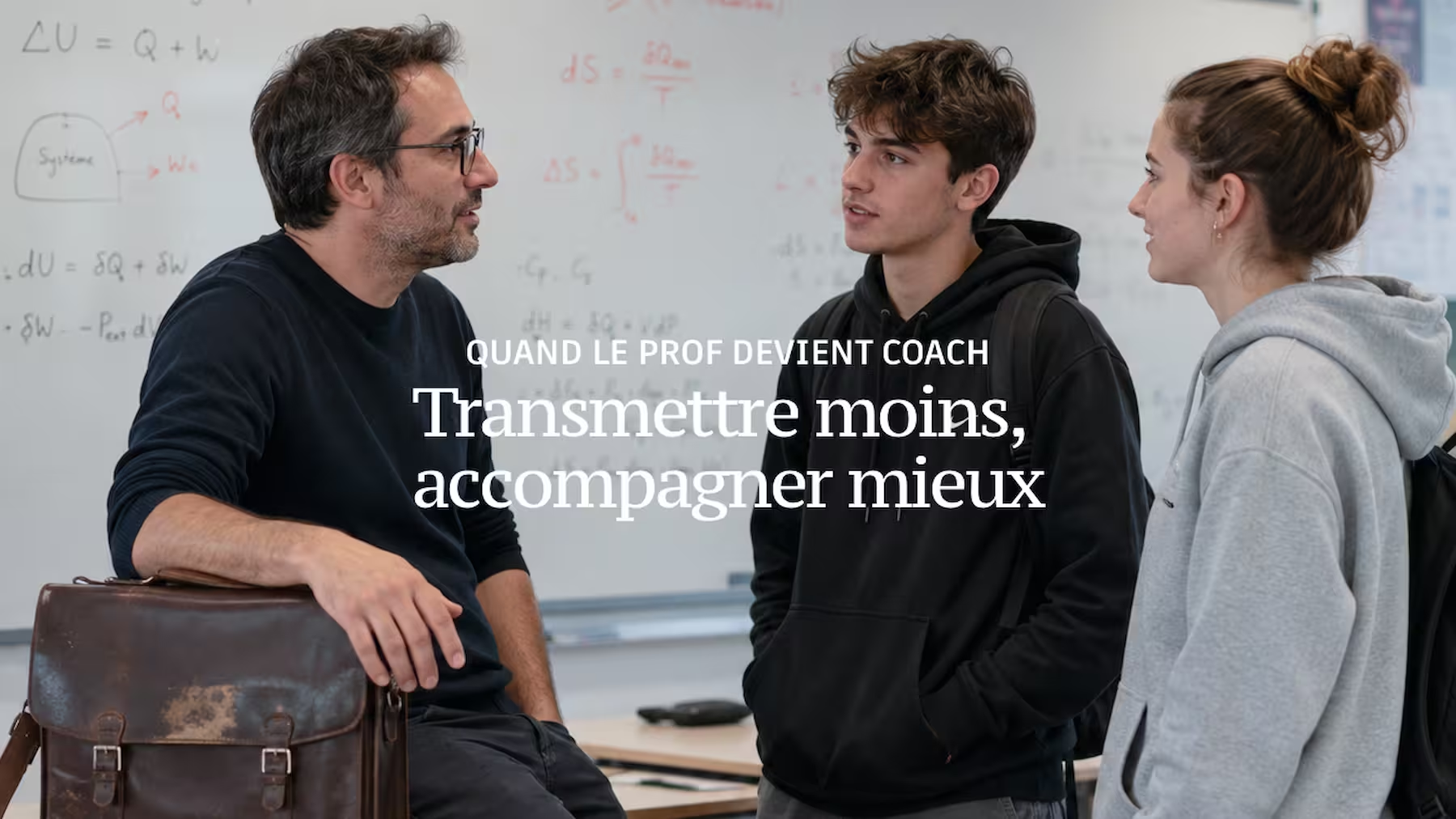
The Teacher as Coach: A Serious Approach, Not a Metaphor
The concept of "pedagogical coaching" has existed for several decades in educational literature (Piaget, Freinet, and their contemporary extensions), but it takes on new operational meaning with AI. Wikipedia defines it as "a model where the teacher shifts from a masterful transmission role to a role of accompanying the learner, in the acquisition of knowledge, collective skills and personal development."
The logic of the pivot is simple. If 80% of the costs of a training system today go toward transmitting information that is freely available everywhere on the internet, and if AI can handle this transmission in a more personalized and less costly way, then the value of the human teacher shifts to what the machine cannot do: reading a student's fragility, maintaining a bond of trust, detecting a first domino that wobbles, and intervening before the entire trajectory collapses.
This redistribution is not a degradation of the teacher's status. It is a redefinition. One coach for 25 students, dedicated to moral support, motivation and resolving life conflicts, represents a more targeted human intervention, and probably more effective, than a teacher managing 35 students in a lecture hall where the most vulnerable are, de facto, invisible.
The model requires three conditions to function. First, genuinely adaptive educational AI, not a mere digital wrapper around a linear course. Second, an explicit budget reallocation from transmission savings to human support positions. Third, a redefinition of initial teacher training, preparing them for this role of resilience coach rather than encyclopedia.
The final, unresolved question is that of systemic dependency. If an entire generation outsources the memorization and formulation of knowledge to digital systems, what happens the day access to these systems is interrupted? This is the structural risk that the "teacher as coach" model must integrate from its conception, by maintaining foundational skill sets that remain anchored in the learner, independent of any technological infrastructure.
Sources
School dropout rate France 2023: INSEE, via Observatoire des inégalités (January 2026), Centre-Inffo (December 2024) 95,000 young people without qualifications per year: education.gouv.fr PISA 2022 results: OECD, DEPP notes n°23.48 and n°23.49, December 2023 Social inequalities and guidance: INSEE (social portrait, 2020), Cnesco (report "La fabrique des inégalités"), France Stratégie (2023), OECD (2024 report) Professional integration: INSEE/InserSup (MESR-SIES), Conférence des Grandes Ecoles 2024, Paris 1 Panthéon-Sorbonne ORIVE survey 2023-2024 AI and education: IGESR report June 2025, MEN framework June 2025, Senate report Bruyen-Fialaire n°101, October 2024 Pedagogical coaching: Wikipedia FR, Cursus.edu, TDFLE journal