
Apprenticeship centres: more than half could be in deficit in 2026. What keeps a programme afloat
For five years, opening an apprenticeship programme was almost always profitable. Not any more. Contract funding levels have been revised, the support fund for apprenticeship centres (CFAs) has been cut eightfold, and apprentice numbers are falling in the crafts sector. For chamber-run and private CFAs alike, the question is no longer just the number of apprentices, but the result of each programme.
The figures
On 30 June 2026, the finance committee of the French National Assembly reviewed the assessment of the effects of cuts to apprenticeship funding. Special rapporteur Emmanuel Maurel gave the following orders of magnitude:
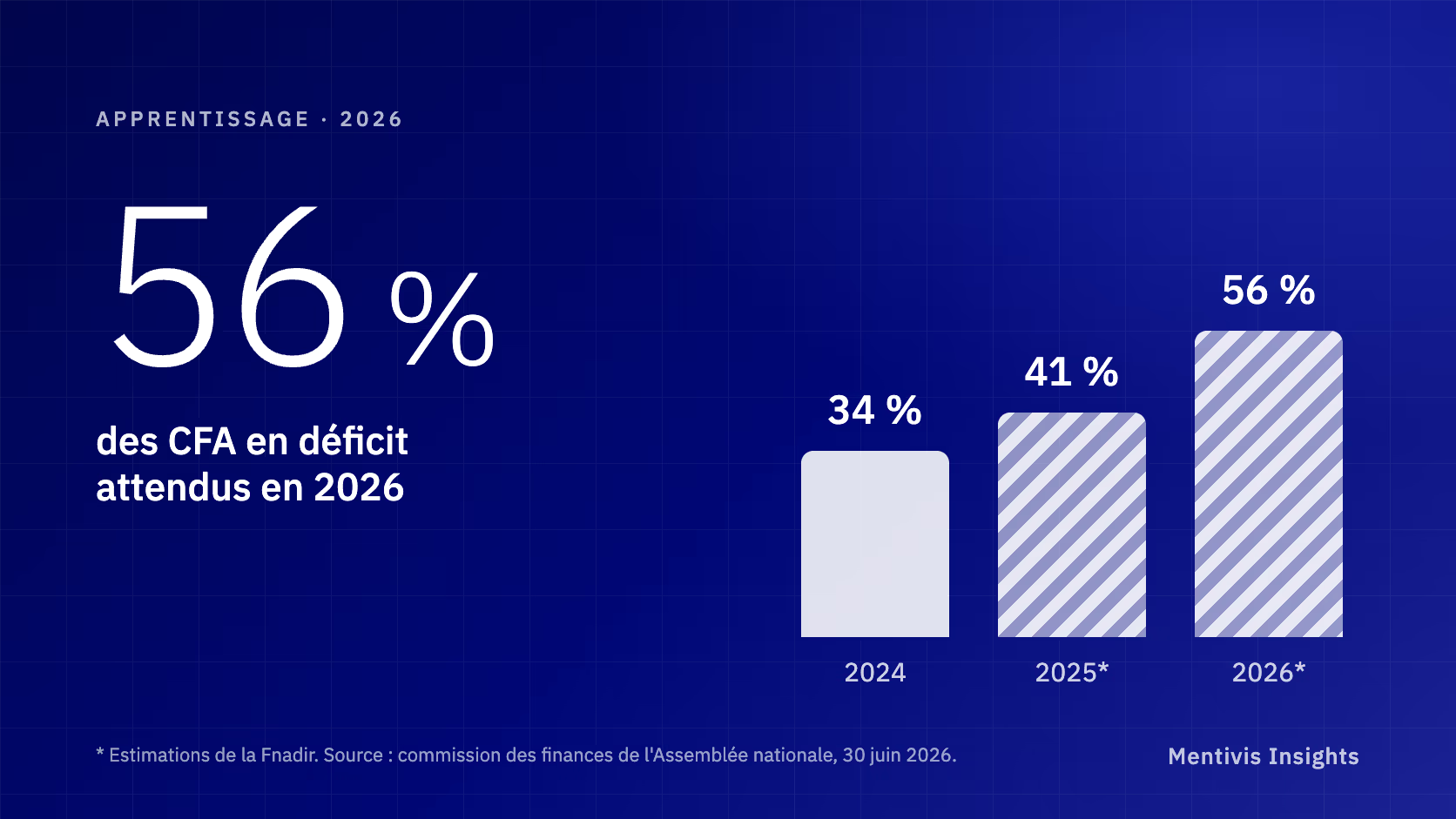
- 34% of CFAs were in deficit in 2024. According to Fnadir, the figure would be 41% in 2025 and 56% in 2026.
- CFAs' margin rate fell from 11% in 2021 to 5.1% in 2024, and to 1.4% for chamber-run structures.
The complementary funding paid by the State to the regions has almost disappeared. The order of 28 May 2026 cuts the apprenticeship support fund to €33 million for 2026 (€11 million for CFA operations, €22 million for investment), down from €268.2 million in 2024 and 2025. The 2027 finance bill plans to remove these regional envelopes and create a targeted national fund, reserved for struggling CFAs that provide priority training (see our analysis of the 2027 budget).
In the crafts sector, the network of chambers of trades described the situation as early as 22 January 2026, in an open letter: more than 110,000 apprentices a year, an average 8% cut in programme operating resources, a loss of around €30 million for 2025 and an operating result below zero. For the first time since 2013, apprentice numbers there are falling, by about 6%.
Chambers of commerce and industry also face a cut in their own resources: article 42 of the 2027 finance bill plans to lower the ceiling of the chamber tax from €505 million to €380 million. This is only a bill: the finance committee adopted an amendment against it, and the outcome of the parliamentary debate remains open.
What changed in per-contract funding
Per-contract funding, paid by the skills operators (OPCOs), remains the basis of the model. Its rules changed in 2025 and 2026:
- New funding levels. On 2 April 2026, France compétences adopted recommendations to industry bodies: a reference value per qualification, based on observed costs and raised by 1.85%, with a framed adjustment margin. Levels are set for at least three years.
- A default decree. Decree no. 2026-832 of 29 August 2026 sets the levels that apply to contracts signed since 1 September 2026 when the industry body has not set its own or has not followed the recommendations. According to France compétences, the weighted average level is stable, but most adjusted levels were revised downwards.
- An employer contribution. Since 1 July 2025, the employer pays the CFA a flat contribution of €750 for each contract preparing a level 6 or higher diploma or qualification (article R. 6332-25-1 of the Labour Code).
As a result, income per contract can fall for the same qualification, and it varies more from one industry to another. A CFA-wide average is no longer enough to know where money is made and where it is lost.
The programme as the unit of management
According to Centre Inffo (9 April 2026), a programme runs at a loss below 12 to 15 apprentices. The exact threshold depends on each CFA: it has to be calculated.
The method. For each programme:
- Income. Number of contracts multiplied by the funding level of the qualification, plus the employer contribution for level 6 and above, plus any other programme-specific funding.
- Direct costs. Teaching hours multiplied by the hourly cost of trainers, programme coordination, technical facilities, materials, exams.
- Share of common costs. Management, administration, premises, employer relations, quality, allocated with a stable key (hours or number of apprentices).
- Break-even point. The number of contracts from which the programme covers its direct costs and its share of common costs.
A fictitious example, for illustration. A programme of 12 apprentices funded at €7,500 brings in €90,000 a year. If it uses 600 teaching hours at €70 an hour, i.e. €42,000, plus €15,000 for technical facilities and materials, it generates €33,000 before common costs. With a share of €3,000 per apprentice, i.e. €36,000, it loses €3,000. One more contract (€7,500 of income, €3,000 of common-cost share) brings it to break-even, with a €1,500 surplus; a common core shared with a neighbouring programme can have the same effect.
Five levers to hold on without closing
- Review the programme map. Merge programmes that are too small, share a common core between related qualifications, open programmes where employers are hiring. A closure is decided on the programme's result, not the CFA's.
- Fill programmes before the start of the year. Recruiting apprentices and managing employer relations become economic functions: a contract signed in September is worth more than one signed in December.
- Mix audiences. Apprentices, employees in continuing education, people retraining or validating prior experience can share modules. Individualised learning paths make this possible without adding teaching hours.
- Use complementary resources. Employer contributions for level 6 and above, the balance of the apprenticeship tax for equipment (it does not fund a CFA's operations), the future national fund for priority training.
- Manage by indicators. Fill rate, contract terminations, result per programme, exam success: tracked every month, not discovered at year end.
Key takeaways
- 34% of CFAs were in deficit in 2024; Fnadir expects 56% in 2026.
- The apprenticeship support fund falls from €268.2 million in 2024 and 2025 to €33 million in 2026.
- Funding levels were revised in 2026; a default decree applies to contracts signed since 1 September 2026.
- Employers have paid €750 per contract at level 6 or above since 1 July 2025.
- Results are managed programme by programme, with a break-even point calculated for each one.
How Mentivis can help
Mentivis is a training operator: we design, open and run schools, apprenticeship centres and training organisations. For a CFA or school under pressure, we take over economic and educational management with the leadership team, without taking ownership of the institution:
- Programme-by-programme diagnosis and economic trajectory: outsourced management of a training organisation.
- Redesign of the programme map or opening of a new CFA: set up a CFA.
- Individualised learning paths to mix audiences without adding hours: MentivisOS.
To review your programmes, book a 30-minute call.
Sources
- National Assembly, finance committee, report no. 116 of 30 June 2026 (assessment of the effects of apprenticeship funding cuts)
- Order of 28 May 2026 setting the amount and allocation of the apprenticeship support fund to the regions (JORF of 30 May 2026)
- Decree no. 2026-832 of 29 August 2026 setting apprenticeship contract funding levels
- France compétences, general review of apprenticeship contract funding levels (3 April 2026)
- Decree no. 2025-585 of 27 June 2025 (employer contribution, article R. 6332-25-1 of the Labour Code)
- Network of chambers of trades, open letter on apprenticeship in the crafts sector (22 January 2026)
- Centre Inffo, CFAs: the battle for quality to survive the crisis (9 April 2026)
- Labour Code, article L. 6241-4 (balance of the apprenticeship tax)
- 2027 finance bill, no. 3210 (National Assembly)
Further reading: obtaining and using apprenticeship tax funds, managing the relationship with OPCOs, attracting apprentices in 2026, the training activity report (BPF) and training market figures.